
Finnish Lapland in winter is a true winter wonderland. If you love experiencing a real Arctic winter, travelling to Finnish Lapland can feel like stepping into a fairytale.
Vast snow-covered forests stretch for miles, crossed by rivers whose powerful currents cut through metres of snow and ice. Tall trees, especially Norway spruce and Scots pine, become completely covered in snow and take on strange, almost organic shapes, looking like giant creatures that have stepped straight out of a fantasy novel.
This extraordinary winter landscape is one of the things that makes Finnish Lapland so special for landscape photography. The forests, frozen lakes, rivers and endless snow-covered landscapes create a completely different setting from the rugged mountains and coastlines of places like Iceland or the Lofoten Islands.
Another advantage of Finnish Lapland is its inland location. Away from the immediate influence of the sea, the region can often offer good opportunities for clear skies during the winter months. When the clouds disappear, the combination of deep darkness, snow-covered landscapes and a sky filled with stars and Northern Lights creates an almost surreal atmosphere.
For a landscape photographer, this is what makes Finnish Lapland such a fascinating place to photograph the Northern Lights. The Aurora does not simply appear above the landscape: it becomes part of an immense Arctic scene made of snow, forests, ice and silence.
In this guide, I will show you five of the best places to photograph the Northern Lights in Finnish Lapland, focusing on the landscapes, viewpoints and photographic possibilities that make each location special.
1. Kuntivaara
We start with one of my favorite locations in Finnish Lapland: Kuntivaara, a forest-covered fell in the eastern part of Kuusamo, very close to the Russian border.
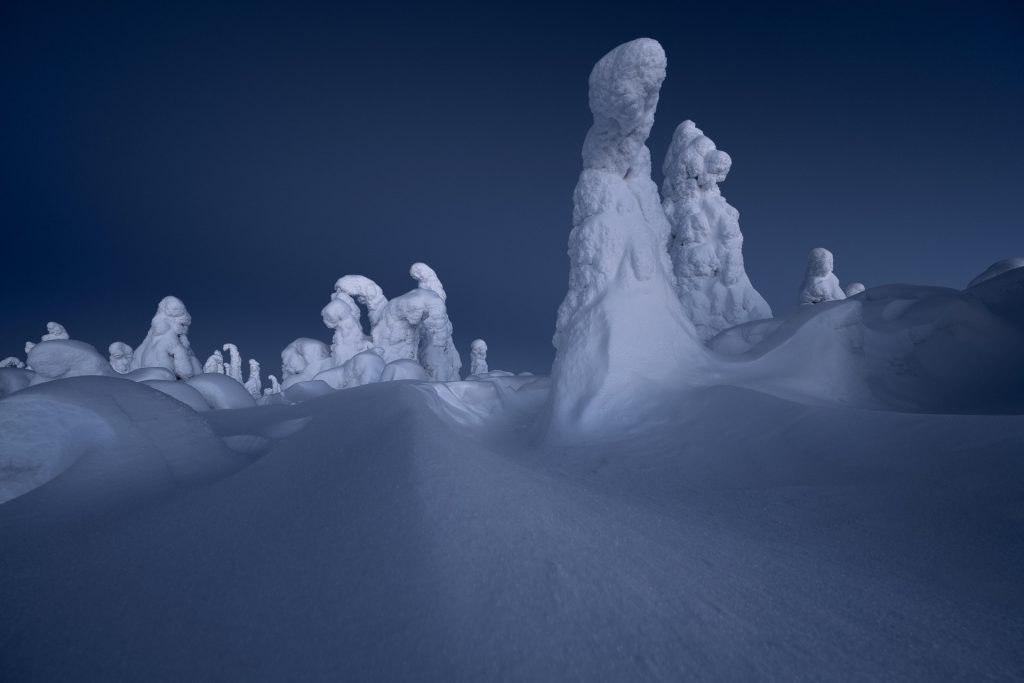
Kuntivaara is one of those places that feels almost unreal in winter. The hill is covered by a dense forest, and the trees become completely covered with thick layers of snow, taking on strange and spectacular shapes. In the right conditions, they almost look like giant white creatures standing in the middle of the Arctic wilderness.
At the top of the fell, you also have an incredible viewpoint over the surrounding landscape, with a 360-degree view across the immense Finnish forests stretching in every direction.
The location can be reached by snowmobile, and this is how I usually visit it with my GoToPhotoTour groups. We often leave before sunrise and ride through the winter landscape in complete darkness, reaching Kuntivaara during the blue hour.
Arriving there in complete silence, surrounded by these enormous snow-covered trees while the first pastel colours of the Arctic sunrise begin to appear in the sky, is an experience that is difficult to describe. It genuinely feels like arriving in another world.
For me, Kuntivaara is one of those places you absolutely have to experience if you are travelling through Finnish Lapland in winter.

Composition Tips
Kuntivaara offers an incredible number of possibilities for creating original compositions. The shapes of the snow-covered trees are constantly changing, and simply moving a few metres can completely transform the image.
I particularly like looking for compositions where one of the giant snow-covered trees can be used as a natural frame around another tree, with the Northern Lights dancing across the sky behind it.
You can also play with the shapes and three-dimensionality of the trees, using them to create layers within the frame. A wide-angle lens works particularly well here, allowing you to get close to the snow-covered trees while still including the surrounding forest and the Northern Lights above.
A good pair of snowshoes is almost essential. The snow can be extremely deep, and if you want to explore between the trees and look for new compositions, I strongly recommend having them with you.
The best approach here is simply to explore the area with your tripod, move between the trees and let their shapes guide you towards new compositions.
2. Riisitunturi National Park
Riisitunturi National Park is another incredible place to explore on foot in Finnish Lapland. The park is quite extensive, and a short hike takes you up towards the top of the Riisitunturi Fell, where the landscape becomes truly spectacular.
Compared with Kuntivaara, the forest here is more open, with the trees more widely spaced and scattered across the slopes of the fell. This makes it easier to explore between them and find interesting compositions without having to work within such a dense forest.
Personally, this is my favorite place in Finnish Lapland for creating Northern Lights photos. The combination of the open slopes, the snow-covered forest and the vast Arctic landscape gives you an incredible number of possibilities.
The park is large enough to allow plenty of scouting, and by moving around the slopes you can find completely different views. Even when photographing the same area, the landscape can look very different depending on which trees you choose and how you position yourself.

Composition Tips
The trees are never exactly the same: their shapes change depending on the amount of snow they carry and how the wind has shaped them over time. This makes exploring the area with your tripod particularly rewarding.
A wide-angle lens works especially well here. You can place a snow-covered tree in the foreground and use it as a natural frame around other trees in the background, with the Northern Lights above them.
One of my favorite possibilities is to find a tree whose branches bend down towards the snow and position myself underneath it. From inside the tree, the snow-covered branches can create a kind of natural cave, framing the trees in the background and the Northern Lights above.
The more you explore, the more unusual foregrounds and natural frames you can find.
As at Kuntivaara, snowshoes are essential if you want to explore the area between the trees. The snow can be extremely deep, so I strongly recommend having a good pair with you.
And make sure you are properly dressed. Spending several hours exploring the slopes and waiting for the Northern Lights in these conditions can be brutally cold, especially when you are standing still behind your tripod.
3. Kiveskoski – Kitkajoki River
Kitkajoki River is one of the most beautiful rivers in Finnish Lapland for observing and photographing the Northern Lights.
The river is quite wide, with a powerful flow of water cutting its way through the snow and ice. It is surrounded by enormous snow-covered trees that become almost completely white during the winter months.
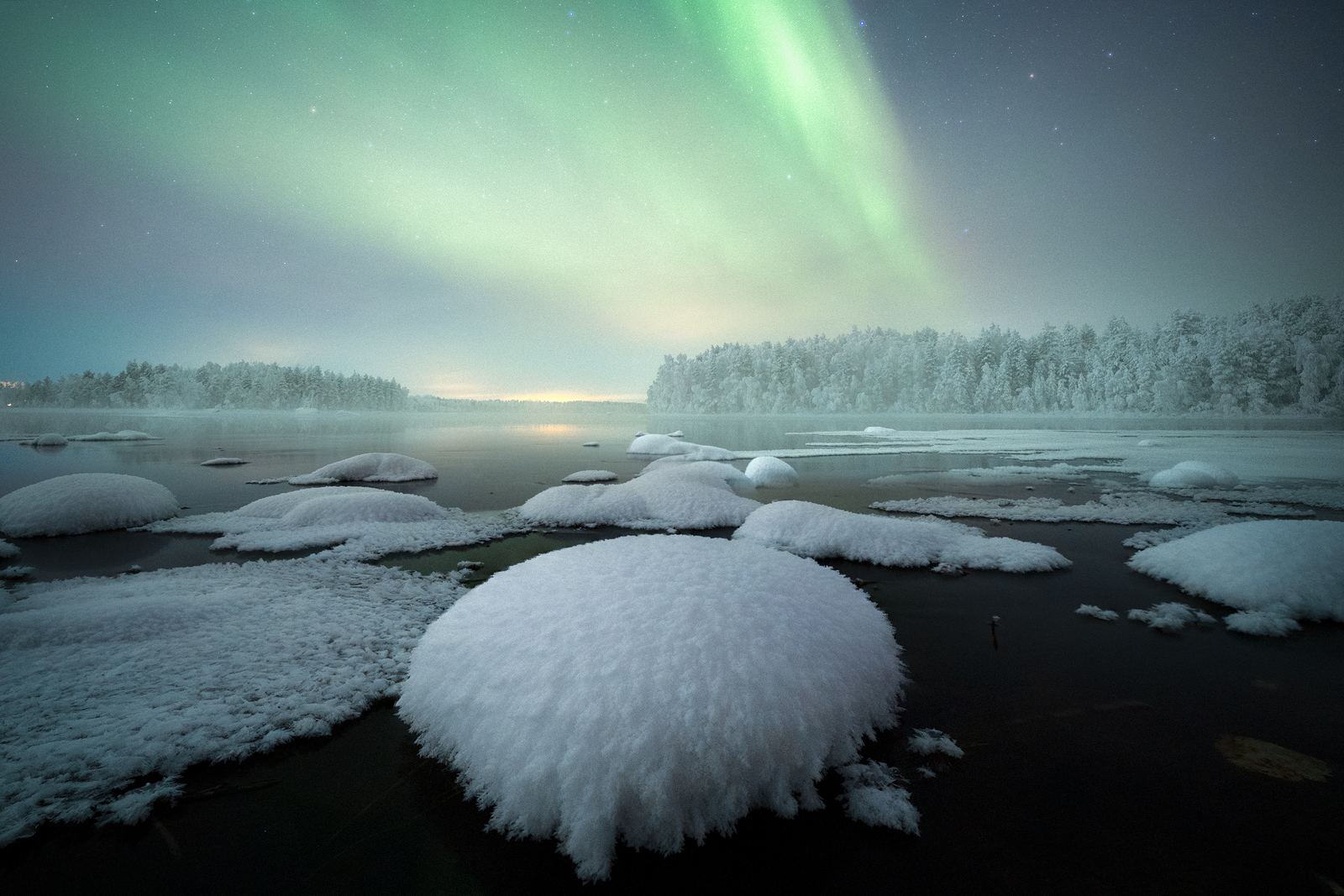
Along the edges of the river, you can often find beautiful ice formations between the rocks, creating another interesting element to work with when building your composition.
The exact photography spot is Kiveskoski, one of the rapids along the Kitkajoki River. This is where I take my photography groups every January to photograph the Northern Lights surrounded by the frozen Arctic landscape.
Composition Tips
The ice formations between the rocks can become excellent foreground elements for your composition.
You do not need an extreme wide-angle lens here, as there are no high mountains on the horizon. Instead, you can work with a wider perspective and concentrate on building depth within the scene.
I particularly recommend placing the tripod very low and getting close to the ice formations, using them as the foreground. From there, the line of the river can guide the eye towards the background, where the giant snow-covered trees surround the water and the Northern Lights dance across the crystal-clear Finnish Lapland sky.
The combination of ice, flowing water, snow-covered forest and Northern Lights creates a very different type of image from the compositions you can create at Kuntivaara and Riisitunturi.
4. Oulanka National Park
Oulanka National Park is another fantastic place to explore when travelling through Finnish Lapland. Located close to Ruka, the park is a vast wilderness area where you can walk for hours and discover completely different landscapes along the way.
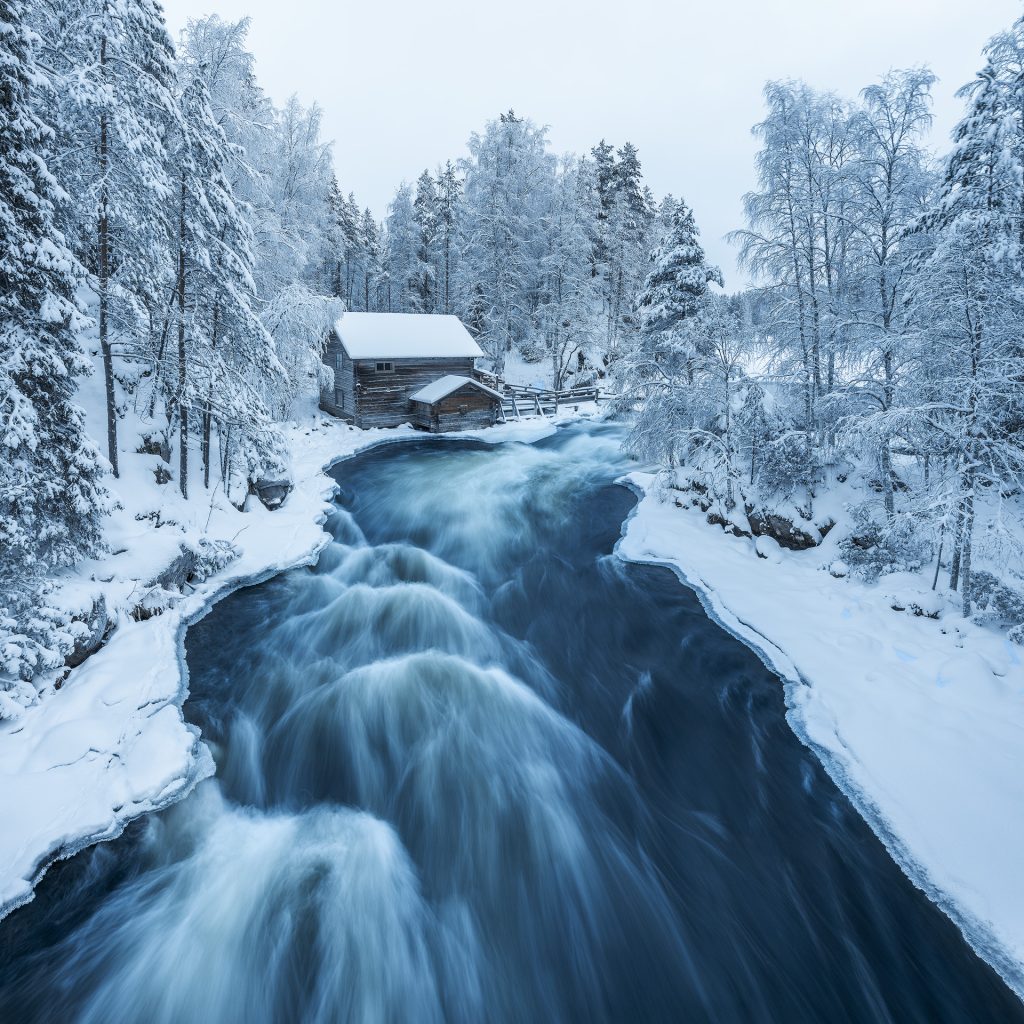
The park is crossed by several rivers, creating a huge variety of photographic opportunities. You can find powerful rapids, winding sections of river and quieter stretches of water where floating blocks of ice gather between the rocks, creating beautiful circular shapes and patterns that can be captured with a long exposure.
This variety is one of the things I particularly like about Oulanka. As you explore the forest, the landscape constantly changes, and you can find open sections of river where the sky opens up above the surrounding snow-covered forest.
Photographing the Northern Lights here can be slightly more challenging, however, because you are still inside the forest and your shooting direction is more limited. Unlike an open fell, where you can see the sky in almost every direction, the trees naturally restrict your view.
For this reason, I look for sections where the forest opens up enough to give the Aurora plenty of space in the sky, while the river, ice and snow-covered trees provide interesting elements for the composition.
This is one of the locations I regularly visit with my GoToPhotoTour groups, precisely because of the variety of landscapes and photographic possibilities it offers.
Composition Tips
Here, I recommend bringing a wide-angle lens and, above all, taking your time to explore the forest. The best compositions are not necessarily found immediately next to the trail, and moving between different sections of the park can reveal completely different foregrounds and shooting positions.
Look for sections of river where the water remains open and where ice formations have developed between the rocks. These can become excellent foreground elements, while the river itself can lead the eye through the frame towards the snow-covered forest and the Northern Lights above it.
Some areas also offer powerful rapids and more dramatic water movement, while other sections of the river are calmer and allow you to work with ice formations and reflections.
Exploring during daylight is therefore particularly important. Oulanka is vast, and there are many different landscapes and photographic possibilities to discover.
If you plan to explore the park at night, snowshoes are strongly recommended, especially away from the main winter trails. And make sure you are properly dressed, because spending several hours outdoors in Oulanka during a winter night can be brutally cold.
For me, the best approach is to explore the area during the day, identify a few promising compositions and then return after dark when the Northern Lights begin to appear.
5. Valtavaara
Valtavaara is one of the highest fells in the Kuusamo area, rising to around 492 metres above sea level. Located close to Ruka, it offers a completely different perspective from the other locations in this guide.
From the summit, the landscape opens up in every direction, with vast views across the snow-covered forests and surrounding fells. This open landscape is particularly interesting for Northern Lights photography because you are not surrounded by dense forest and can turn in different directions depending on where the Aurora begins to appear.
It is also a great place to photograph weaker Northern Lights. When the Aurora is still low on the northern horizon and has not yet developed enough to fill the entire sky, the elevated position and open views allow you to include it above the vast Finnish landscape.
The trees around the summit are more widely spaced and generally lower than those at Kuntivaara and Riisitunturi, making it easier to move around and find a clear shooting position.
For me, Valtavaara is therefore one of the best places in the Ruka area to photograph the Northern Lights, particularly when the Aurora is not extremely strong.
Composition Tips
Here, you can make great use of a wide-angle lens to create depth and three-dimensionality in the landscape. By carefully positioning yourself between the snow-covered trees, you can create different layers within the frame, using trees at different distances while leaving plenty of space for the Northern Lights above.
The more open landscape also gives you much more freedom to choose your shooting direction, making Valtavaara a simpler location from which to photograph the Northern Lights. Unlike a composition inside a dense forest, you can turn around and adapt your position depending on where the Northern Lights appear.
This is particularly useful when the Aurora is weak and remains low on the northern horizon. Instead of waiting for it to move directly above you, you can simply position yourself towards the northern sky and build the composition around the landscape in front of you.
From the summit, you can also use the surrounding fells and snow-covered forests as layers in the background, creating a sense of depth while the Northern Lights dance above the landscape.
This combination of elevation, open views and freedom to change shooting direction makes Valtavaara an excellent location for Northern Lights photography in the Ruka area.
If you would like to photograph the best of Finnish Lapland for yourself, join us on our Winter Lapland Photo Tours.
Conclusion
Finnish Lapland is a place where the silence of the Arctic wilderness meets a landscape that often feels almost unreal.
Here, you can experience a real Arctic winter, walking through endless snow-covered forests, frozen rivers and open fells while the Northern Lights dance above you.
There is something magical about photographing these landscapes. For a few hours, the line between reality and a fairytale seems to disappear, creating the perfect setting for photography that feels completely different from the classic Northern Lights images.
If you are looking for a place where you can experience the true Arctic winter and create unique and atmospheric Northern Lights photos, Finnish Lapland offers something truly special.

