
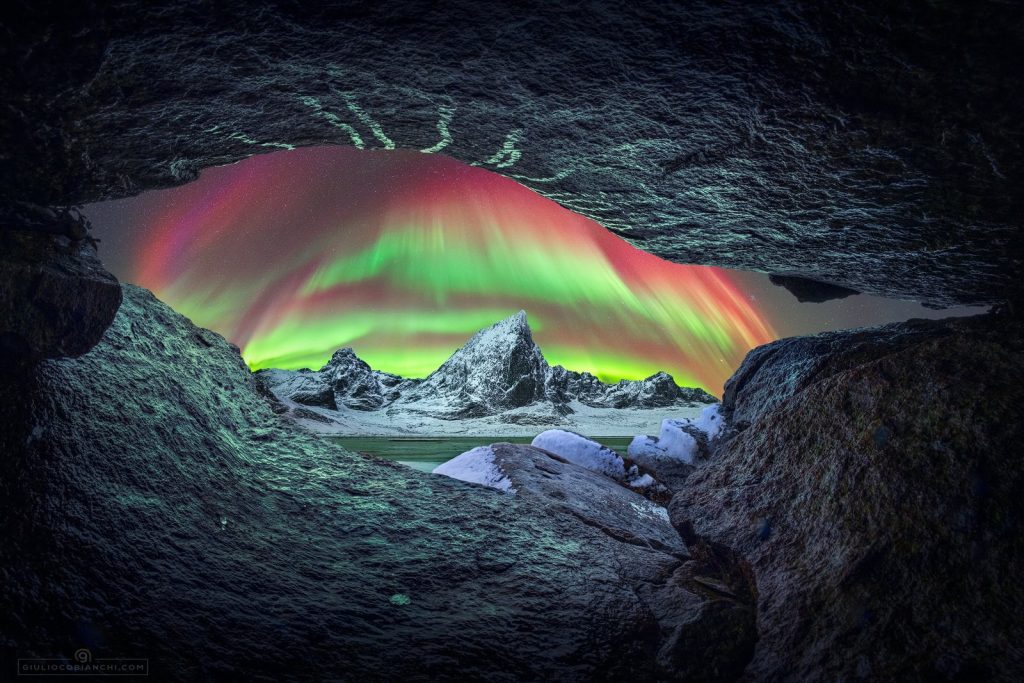
The dramatic landscapes of the Lofoten Islands make this Arctic archipelago one of the best places in the world to photograph the Northern Lights.
These small islands, connected by bridges and underwater tunnels, are a true paradise for landscape photographers. In just a few minutes by car, you can reach an incredible variety of locations and create compelling images in completely different settings.
In some places, the composition almost seems to create itself. You simply put your tripod down, point your camera towards the landscape and the result can already be next level.
Rugged mountains rise directly from the ocean, creating spectacular fjords surrounded by Arctic landscapes. Add the traditional red fishing villages, scattered along the coastline and beneath the mountains, and the result is an almost surreal atmosphere.
But finding a beautiful location is only the beginning. For Northern Lights photography, knowing where to position yourself and how to build the composition can make all the difference. A particular rock formation can become the perfect foreground, waves breaking along the shore can add movement to the image, while a clear view towards the northern sky can give the Aurora the space it needs to become part of the composition.
In this guide, I will show you five of the best places to photograph the Northern Lights in the Lofoten Islands, focusing not only on what makes each location special, but also on how to approach the composition. For each spot, I will share practical photography tips, including possible foregrounds, backgrounds, shooting directions and the elements I look for when building a composition.
1. Kilan Lagoon
The Kilan area and its nearby lagoon are my favorite place in the Lofoten Islands for landscape photography. Unlike locations where there is one obvious viewpoint, here you can find countless different compositions simply by walking for five or ten minutes with your tripod.
The landscape is dominated by a rugged mountain range rising beyond the lagoon, with a distinctive peak standing out above the surrounding mountains. From different positions around the lagoon, you can use the mountains in completely different ways, making them a strong and recognizable background for your images.
The real strength of Kilan, however, is the variety of foregrounds you can find depending on the season, tide and weather conditions.
Composition Tips
When photographing the Northern Lights at Kilan, I like to start by looking for an interesting foreground and then work the composition around the mountains and the sky.
The mountains give you a strong background, while the open view towards the north leaves plenty of room for the Aurora to appear behind them. The foreground is what allows you to make each photograph different.
Depending on the conditions, you may find floating blocks of ice in the lagoon, pieces of ice resting on the frozen sand after the tide has gone out, or unusual ice formations along the shoreline.
Among the most interesting are the formations photographers often call “dragon eggs.” These rounded pieces of sea ice form when the frozen sea breaks apart and the pieces are pushed against rocks by the movement of the tide. They make great foreground subjects, especially when you can use their shapes to lead the eye towards the mountains.
Small streams flowing down from the surrounding mountains can also work really well in the foreground. By placing the tripod in the right position, you can use the stream as a natural leading line, taking the viewer from the bottom of the frame towards the mountains.
Then you have the Aurora above it all. With the northern sky opening up behind the mountains, you can bring together the foreground, the landscape and the Northern Lights in a single frame.
The great thing about Kilan is that you do not have to settle for one composition. Walk for a few minutes, move the tripod, look for another foreground and the photograph can change completely. Ice formations, flowing water, frozen sand and the lagoon itself can all give you a different way of photographing the same mountains and the same Northern Lights.
For this reason, Kilan is one of those places where exploring the area with your tripod is almost as important as waiting for the Aurora itself.
2. Uttakleiv Beach
Also known as Dragon Eye Beach, Uttakleiv Beach is one of the most famous and iconic locations in the Lofoten Islands.
The beach offers a wide-open view towards the north, while the mountains are relatively distant from the shoreline. This makes Uttakleiv particularly interesting for Northern Lights photography, even when auroral activity is weak and the Aurora appears only as a faint band on the northern horizon.

Composition Tips
Uttakleiv offers countless possibilities for different compositions, with a variety of foreground elements that can completely change the way the scene is framed.
In the first section of the beach, you can work with the many smooth, rounded stones along the shoreline. In winter, these rocks are often covered with ice or snow, creating interesting textures and shapes in the foreground. When the Aurora is visible, the wet or icy surfaces can also pick up its green glow, adding another layer to the composition.
The waves breaking between the rocks are another element worth looking for. By working close to the shoreline and using a low camera position, you can incorporate the movement of the water into the foreground, creating natural leading lines that draw the eye towards the mountain in the background. With the northern sky opening up behind the mountain, the Aurora can then complete the composition.
The most iconic composition at Uttakleiv is found a few minutes further along the left side of the beach. A short trail follows the rocky coastline and, after about five minutes, leads to the famous Dragon Eye.
The Dragon Eye is a perfectly rounded rock sitting inside a small natural pool of water, formed in a hollow in the rock. At low tide, you can place your tripod very low in front of it and use the rock as a strong foreground element.
The same mountain rises in the background, while the northern sky remains completely unobstructed behind it. This combination gives you an excellent chance of capturing even relatively weak auroral activity while keeping the foreground, mountain and sky all working together in the frame.
It is one of the classic compositions in the Lofoten Islands. It may be a familiar image, but when the conditions come together, it is still an incredibly rewarding photograph to create.
3. Vik Beach
Vik Beach is the beach closest to Leknes, the main town in the central part of the Lofoten Islands, and it offers plenty of possibilities for Northern Lights photography.
When I am leading photography groups, I often prefer waiting for the Northern Lights at Vik Beach rather than at nearby Haukland Beach, on the other side of the bay. The two beaches share the same mountain, Mannen, but the perspective is quite different.
At Haukland, you are much closer to the mountain and lower down in relation to it, so Mannen appears much higher in the frame. This means that you may need stronger auroral activity for the Northern Lights to rise above the mountain.
From Vik Beach, you are farther away from Mannen, giving you a more open view towards the northern horizon. This can make a big difference when the aurora is weak and stays low in the sky, as you have more chance of keeping it visible above the mountain.

Composition Tips
One of the things I like most about Vik Beach is the variety of foregrounds you can find without having to move very far.
At low tide, the wet or partially frozen sand can make a beautiful foreground. When the Aurora is active, the thin layer of water left on the beach can pick up its green light and create subtle reflections.
The sand also develops interesting patterns as the tide goes out. Small channels, ripples and lines can be used to lead the eye from the foreground towards Mannen and the Northern Lights above it. By moving a few metres and changing your shooting angle, you can often find completely different compositions.
On the left side of the beach, you can walk for a few minutes along the rocky coastline and reach an area with several small pools. Depending on the conditions, some may be frozen while others still contain water.
These pools are particularly interesting as foregrounds. You can place the tripod low and use the water to reflect the Aurora, while the surrounding rocks and ice add texture and help frame the bottom of the image.
With the right position, you can bring together the reflections and textures in the foreground, Mannen in the background and the open northern sky above it.
I particularly like this area because you can keep moving and look for new compositions as the conditions change. You are not tied to one specific viewpoint: you can work with the sand, the pools, the rocks or the reflections, depending on what you find on the night.
For me, this is one of the most interesting areas in Lofoten precisely because there are so many different compositions to explore within a relatively small area.
4. Reinefjorden
Reinefjorden is one of the most spectacular fjords in the Lofoten Islands, and the number of photographic possibilities here is almost endless.
Even moving just a few minutes by car can completely change the view. You can find a different foreground, change the direction you are shooting and work with completely different elements in the background.
The area around Reinefjorden includes small fishing villages such as Hamnøy, Sakrisøy and Reine. This means that light pollution is higher than in some of the more isolated locations in Lofoten, and the night sky is not always as dark. But what you lose in darkness, you more than make up for with the scenery.
The landscape here is almost surreal. Rugged mountains rise directly from the fjord, small red fishing cabins are scattered along the shoreline and, when the Northern Lights appear above the mountains, the whole scene can look almost like a fairytale.

Composition Tips
One of the most interesting things about Reinefjorden is that there is no single composition that defines the area. You can spend hours moving between different spots and working with completely different foregrounds.
One possibility is to look for small pools of water along the shoreline. Depending on the temperature and weather, some of these pools may be partially frozen. From a low position, they can make a great foreground and give you the chance to capture reflections of the Northern Lights.
Behind the pools, you can bring together the typical red rorbuer, the rugged mountains and the Aurora in the sky. The combination of the red cabins, dark mountains and green Northern Lights can create a very distinctive Lofoten photograph.
As you move towards Reine, the landscape changes again. The shoreline becomes more rugged, with rocks, stones and small caves that can be used to build a completely different composition.
Here, I like to look for a position where the rocks in the foreground frame the mountains in the distance. With the Aurora moving above the peaks, you can create an image that feels much wilder and more dramatic than the compositions around the fishing villages.
The great thing about this area is that you can keep changing your position. Move the tripod a few metres, drive to another part of the fjord or simply explore a different section of the coastline, and suddenly you can have a completely different photograph in front of you.
You could easily spend an entire week around Reinefjorden and still keep finding new compositions.
There is, however, a small challenge here. Reinefjorden is not as easy to photograph as some of the other locations in this guide. The area is large, the light pollution is higher and moving from one photographic spot to another can take more time.
For this reason, I strongly recommend scouting the area during the day. Take some time to explore the different roads and shorelines, look for interesting foregrounds and identify a few possible positions before the night begins.
Once the Aurora appears, you do not want to be driving around trying to find a composition. Knowing the area in advance allows you to move quickly between the spots you have already explored and concentrate on what is happening in the sky.
Reinefjorden is therefore a location where good daytime scouting can make a huge difference. The photographic possibilities are enormous, but knowing where to go when the Northern Lights appear is the key to making the most of them.
5. Molvena Waterfall
Molvena Waterfall is one of the hidden gems of the Lofoten Islands. It is slightly off the beaten track compared with some of the more famous photography locations, and finding a strong composition for the Northern Lights here is more challenging.
But when the conditions come together, this can produce some of the most spectacular Northern Lights photographs in Lofoten.
The location is formed by a river flowing down from the mountains before reaching the fjord. As it descends towards the valley, the river creates three small waterfalls, each separated by only a few minutes of walking.
The main attraction is the mountain rising directly behind them. It is an enormous, imposing mountain that completely dominates the landscape and gives the location a very different feel from many of the more open coastal spots in Lofoten.

Composition Tips
Molvena is not an easy location for Northern Lights photography, mainly because the view and the compositions are not facing north. This means that you need the Aurora to become active in exactly the part of the sky visible from the river.
If the Northern Lights appear in the right place, however, the result can be spectacular.
One of my favorite ways to photograph this location is to work very low with the tripod and use one of the small waterfalls as the foreground. From a low position, the falling water becomes much more prominent in the frame, while the perspective makes the enormous mountain behind it feel even more imposing.
You can then place the mountain in the background and, if the Aurora is strong enough to appear above its summit, bring the three elements together: the flowing water in the foreground, the mountain rising above it and the Northern Lights dancing across the sky.
When everything comes together, it is a next-level composition.
There are several different positions along the river, so it is worth walking between the three waterfalls and looking for different ways to work with the water. You can move the tripod, change your shooting position and use different sections of the river as foregrounds while keeping the mountain as the main background.
Because you are working very close to the mountain, I recommend using the widest lens you have. The extra field of view makes it much easier to fit the waterfall, the entire mountain and enough sky into the frame.
Unlike some of the other locations in this guide, you cannot simply wait for a weak Aurora to appear low on the northern horizon. You need the Northern Lights to develop in the specific part of the sky above the mountain. That makes Molvena more challenging to photograph, but it is also what makes the location so rewarding when everything lines up.
If you would like to photograph some of these locations for yourself, including both famous spots and hidden gems, take a look at our Lofoten Photography Tours.
Conclusion
The Lofoten Islands offer an incredible variety of locations for Northern Lights photography, from iconic beaches and fishing villages to hidden waterfalls and remote fjords.
The key is not simply to find a place where you can see the Aurora, but to find a composition where the landscape and the Northern Lights work together.
With the right location, a little scouting and some flexibility, Lofoten offers almost endless possibilities for creating unique Northern Lights photographs.

